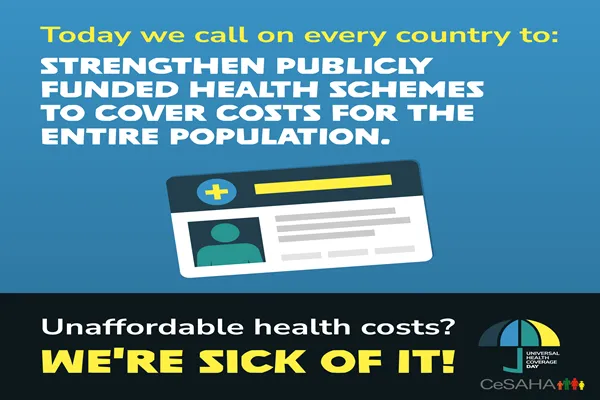
International Universal Health Coverage Day
Unaffordable Healthcare Costs: Why Universal Health Coverage Must Start with PHCs and Schools

Universal Health Coverage (UHC) is often discussed in terms of national insurance schemes and hospital-based care. Yet for millions of households, the true test of UHC is simpler: Can I afford care when my child is sick?
The 2025 UHC Day theme “Unaffordable health care costs. We are sick of it.” reflects a global reality. Despite progress in service availability, out-of-pocket payments continue to drive families into poverty, particularly for basic services that should be universally accessible (WHO & World Bank).
Why PHC Is the Affordability Engine
Primary Health Care is the most cost-effective pathway to UHC. Evidence consistently shows that health systems anchored in strong PHC achieve better outcomes at lower cost (WHO, 2018). When PHCs are functional, accessible, and trusted:
●Illness is detected earlier
●Complications are prevented
●Costly hospital admissions are reduced
CeSAHA’s PHC work focuses on revitalizing community health centres, improving service quality, workforce motivation, governance, and integration with insurance and referral systems. This is not charity; it is smart health financing.
Why School Health Is a UHC Accelerator
School Health Programmes (SHPs) are among the most underutilized tools for UHC. Yet schools provide structured access to children at a stage when prevention yields the highest lifetime returns.
CeSAHA’s SHP work identifies and addresses:
●Undiagnosed vision, hearing, and chronic conditions
●Nutrition and mental health challenges
●Health barriers that directly impair learning and future productivity
By shifting care upstream, SHPs reduce downstream healthcare costs and protect families from avoidable expenditure later in life.
Coverage Without Affordability Is Not UHC
The World Bank has shown that service coverage can improve while financial protection worsens. This paradox underscores a critical lesson: UHC must be designed around people’s financial realities, not just policy targets.
At CeSAHA, we view PRIMARY HEALTH CARE (PHC) and School Health (SHP) as complementary pillars of an affordable UHC pathway, one that prioritizes prevention, early intervention, and equity.
The Road to 2030
As the world accelerates toward the UHC 2030 deadline, CeSAHA aligns with the global roadmap while emphasizing local execution. Universal Health Coverage will not be delivered solely by national declarations, but by strong primary care systems and healthy schools embedded in communities.
On this UHC Day, we add our voice to a growing global call:
Health systems must protect households, not bankrupt them.
