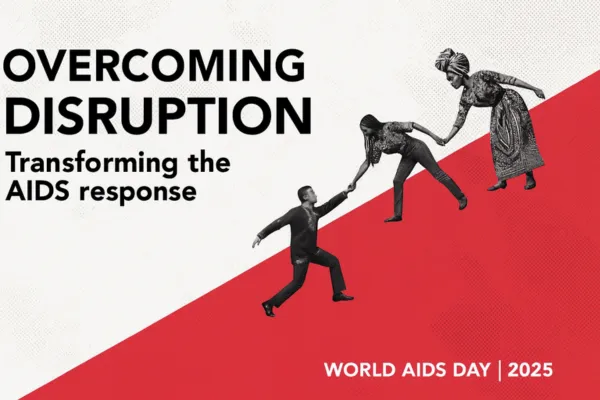
Overcoming Disruption, Transforming the AIDS Response
World AIDS Day provides an annual space to reflect, honour lives lost, and reaffirm global commitment to ending HIV/AIDS. This year’s theme, “Overcoming Disruption, Transforming the AIDS Response, is a timely reminder that progress is fragile and that building resilient health systems is essential to protecting vulnerable communities.
According to UNAIDS, 39 million people were living with HIV in 2023, with 630,000 AIDS-related deaths, despite the availability of effective treatment (UNAIDS, Global AIDS Update 2023). These figures reflect the urgency of strengthening health, social, and community systems.
Global Disruptions and Uneven Progress
In recent years, pandemics, economic instability, misinformation, and political fragility have disrupted HIV services globally. The World Health Organization reported significant interruptions in HIV testing, prevention, and continuity of treatment during the COVID-19 era (WHO, 2022).
These disruptions highlighted a central truth:
“Health outcomes depend on strong systems, not isolated interventions.”
Understanding the UNAIDS 95–95–95 Targets
A major benchmark guiding global HIV efforts is the 95–95–95 framework, which states that by 2030:
95% of people living with HIV should know their HIV status
95% of those diagnosed should be on sustained antiretroviral therapy (ART)
95% of those on treatment should achieve viral suppression, where the virus becomes undetectable and untransmittable (“U = U”)
These targets are grounded in evidence showing that early diagnosis, consistent treatment, and viral suppression dramatically reduce deaths and new infections (UNAIDS, 2014; UNAIDS, 2023; WHO, 2021).
Countries such as Botswana, Rwanda, Tanzania, Eswatini, and Zimbabwe have already achieved the 95–95–95 benchmark, demonstrating what is possible with strong political will, community leadership, and resilient health systems.
A Systems Approach to Ending AIDS
CeSAHA believes that transforming the AIDS response requires an all-society, all-systems approach. Biomedical solutions are essential, but insufficient on their own. Sustainable progress must address the underlying social determinants of health:
Key Systemic Priorities
Strengthen primary healthcare systems to guarantee continuity of HIV services during emergencies
Expand prevention strategies, including PrEP, harm-reduction programs, and youth-friendly digital outreach
Support community-led responses, which UNAIDS recognizes as vital for epidemic control
Combat stigma and misinformation, which continue to undermine testing and treatment adherence
Integrate HIV services with maternal, child, TB, hepatitis, and NCD care
Increase domestic financing to protect HIV programs from global economic shocks
This systems approach aligns with evidence from the Lancet HIV Commission (2021), which emphasizes the power of community-centred and integrated health systems.
Africa’s Demonstrated Leadership
African countries continue to show remarkable leadership in the fight against HIV. Achieving the 95–95–95 targets, once considered ambitious, now represents a lived reality in several countries. Their success reveals a pattern:
“When political commitment meets strong community engagement, transformation happens.”
This momentum must be expanded across the continent and supported through policy, innovation, and sustained investment.
CeSAHA’s Commitment
As we commemorate World AIDS Day 2025, CeSAHA remains steadfast in its mission to advance universal health coverage, strengthen primary health care, and champion community-driven solutions. Ending AIDS is not a health-sector duty alone; it is an all-society responsibility.
No child, adolescent, or adult should be left behind.
No one should die from a preventable or treatable disease.
And no community should be defined by inequality.
Together, we can overcome disruption.
Together, we can transform the AIDS response.
Together, we can build a future that is healthier and more egalitarian for all.
